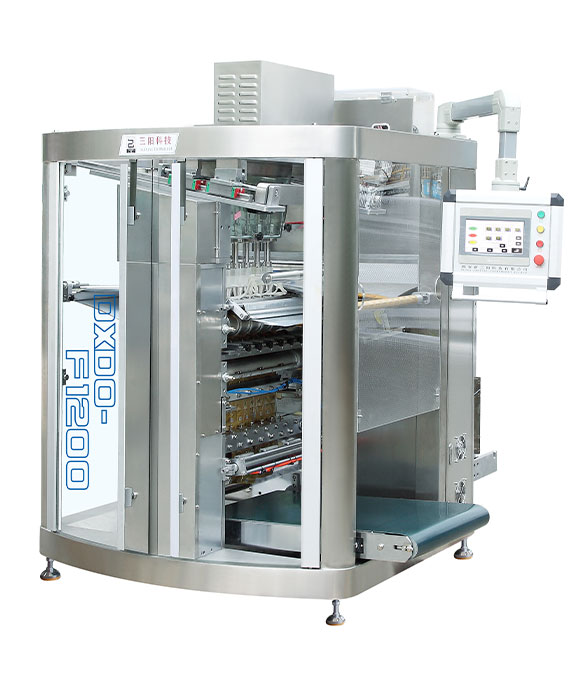
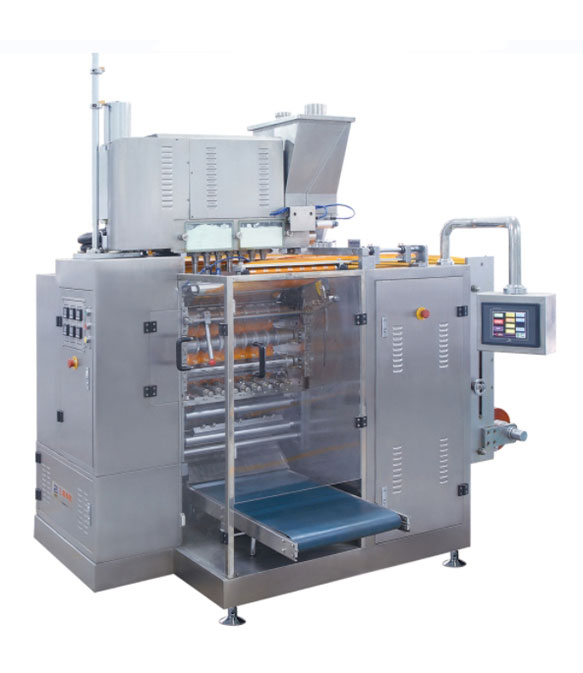
You've just opened a single-serve sachet of soy sauce at a restaurant table, or torn the corner off a liquid medicine packet at home. That flat, sealed pouch didn't come from a manual process. A Liquid Packaging Machine takes a roll of film, forms it into a pouch, fills it with a measured dose of liquid, and seals all four edges in one continuous motion. This article explains how the four-side sealing process works, what keeps liquid inside without leaking, and what to consider when you're specifying a machine for food, pharmaceutical, or chemical sachets.
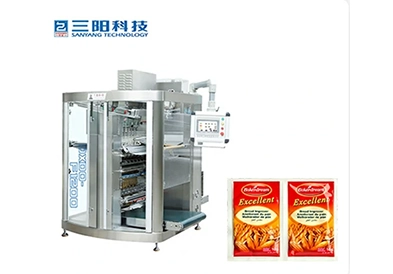
Liquid filling accuracy starts with the pump. The DXDO-Y900EW uses a centrifugal liquid pump filling system, which moves liquid through the line at a controlled rate and delivers a precise volume into each pouch. The fill range runs from 1ml to 100ml, covering everything from small condiment sachets to larger liquid medicine doses.
Centrifugal pumps work well for low-viscosity liquids — soy sauce, vinegar, wine, water-based medicines, and chemical agents. The pump's output is synchronized with the pouch forming cycle, so the fill happens at the exact moment the pouch is open and positioned under the nozzle. If the pump runs too fast, liquid splashes onto the seal area and weakens the seal. If it runs too slow, the pouch moves on before the fill is complete. The control system ties the two motions together.
Every millilitre of liquid that lands in the seal zone is a potential leak path. The machine's filling nozzle is positioned to drop liquid into the center of the pouch, away from the edges that will be sealed. The four-side sealing format gives more room for error than a three-side or pillow bag because the fill opening is separate from the side seals. The machine can adjust sealing direction through the human-machine interface, which lets operators tune the seal position for different pouch layouts.
The sealing mechanism is the heart of any liquid sachet machine. The DXDO-Y900EW uses high-precision integral rolling heat-sealing rollers. Instead of a stamping press that closes and opens in discrete steps, the rollers rotate continuously and press the film layers together as the web moves through. That continuous rolling action produces a smooth, uniform seal across the full pouch width.
The rolling motion also reduces the chance of trapping liquid in the seal. A stamping press can push liquid toward the edges as it closes; a rolling seal squeezes the film progressively from one side to the other, giving any stray liquid a path to escape before the seal forms. The result is a seal that's smooth and delicate on the finished package, with consistent strength across the entire seam.
The heat-sealing rollers are temperature-controlled, so the seal forms at the right temperature for the film being used. Too hot and the film burns through or stretches; too cold and the seal doesn't bond. The machine's control system manages the roller temperature as part of the overall process, and the human-machine interface lets operators set parameters for different film types and production runs.
| Parameter | DXDO-Y900EW Specification |
|---|---|
| Pouch length | 50-150mm (adjustable) |
| Pouch width | 32-105mm |
| Packing speed | 30-60 times/min (depends on pouch size & material) |
| Filling capacity | 1-100ml |
| Applicable film | PET/AL/PE, PET/PE, NY/AL/PE, NY/PE |
| Max film width | 450mm |
| Max film diameter | Φ300mm |
| Film core diameter | Φ75mm |
| Electric source | 380V 50Hz (customizable) |
| Total power | 12KW |
| Overall dimensions | 1500×2600×2000mm (L×W×H) |
| Machine weight | 1500kg |
The film you choose determines how long the liquid inside stays fresh and how well the seal holds. The DXDO-Y900EW runs PET/AL/PE, PET/PE, NY/AL/PE, and NY/PE laminates. Each structure has a different barrier profile.
PET/AL/PE includes an aluminum foil layer that blocks light, moisture, and oxygen. That's the standard choice for products with long shelf life, like liquid medicines or sauces that need protection from light degradation. NY/AL/PE uses nylon instead of polyester as the outer layer, which adds puncture resistance — useful for sachets that might be handled roughly. PET/PE and NY/PE are clear laminates, used when you want the liquid visible through the film.
The film also has to seal at the temperature the rollers deliver. Different laminate structures have different seal initiation temperatures, so the machine settings change when you switch film types. The DXDO-Y900EW's human-machine interface lets operators save parameters for each film structure, which reduces setup time between runs.
The machine uses a dual photoelectric complementary tracking system to keep the printed pattern aligned on each pouch. The tracking system reads registration marks on the film and adjusts the web position so the cut and seal land in the right place relative to the printed design. Without that tracking, the print would drift across the pouch, and a sachet with an off-center logo looks like a quality defect. The complementary dual-sensor setup means the system can track marks even if one sensor loses contrast.
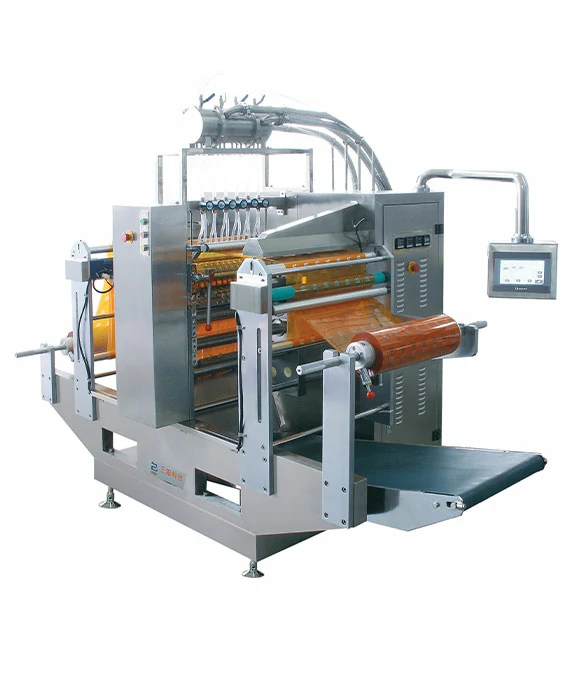
Four-side sealed liquid sachets show up wherever a product needs to be portioned into a single-use package. The DXDO-Y900EW handles liquids across several industries:
Food and beverage — soy sauce, vinegar, cooking wine, condiments, drink mixes
Pharmaceutical — liquid medicines, oral solutions, water-based formulations
Daily chemical — shampoo sachets, detergent samples, personal care liquids
Chemical — water-based chemical agents, cleaning solutions, industrial liquids
The common thread is a product that's liquid at room temperature and needs to be sealed into a flat, stackable pouch. Sachets are cheaper to produce than bottles, lighter to ship, and easier for the end user to open and use in one go. A Liquid Packaging Machine like the DXDO-Y900EW from Chinapack Machinery fits into these production lines with a 30-60 packs/min output rate, which translates to steady throughput without the bottlenecks of slower filling methods. The machine also supports additional function settings to meet specific customer requirements.
The pouch length range is 50-150mm and the width range is 32-105mm. Match those dimensions to the product dose and the target retail or food service format. A 5ml soy sauce sachet uses a smaller pouch than a 50ml liquid medicine dose. The machine's adjustable pouch length means you can change sizes by setting the parameters on the interface rather than changing mechanical parts.
Start with the shelf life and light sensitivity of the liquid. If the product needs a long shelf life and light protection, an aluminum foil laminate like PET/AL/PE or NY/AL/PE is the right choice. If the product is clear and you want it visible, a PET/PE or NY/PE structure works. The film must also seal at the temperature the rollers deliver, so test the film on the machine before committing to a large order.
A centrifugal pump moves liquid continuously and is suited to low-viscosity fluids like water-based sauces and medicines. A piston filler uses a positive displacement action and can handle thicker or more viscous products, but it's mechanically more complex. The DXDO-Y900EW uses a centrifugal system because it's reliable for the low-viscosity liquids that make up most sachet products.
The filling nozzle position and the timing of the fill cycle determine how much liquid ends up near the seal zone. Run the machine at a speed that allows the fill to complete before the pouch moves to the sealing station. Check the seal area on sample pouches regularly — a clear seal with no trapped liquid is the sign that the fill and seal timing are correct. The four-side sealing format gives more clearance between the fill point and the seal edges than a three-side pouch, which helps prevent contamination.
A Liquid Packaging Machine should match your product's viscosity, fill volume, and target pouch dimensions — not the other way around. The DXDO-Y900EW Liquid Sachet and Pouch Packaging Machine from Chinapack Machinery runs at 30-60 packs/min with a 1-100ml fill range, handles pouch sizes from 50-150mm long and 32-105mm wide, and accepts PET/AL/PE, PET/PE, NY/AL/PE, and NY/PE films. The centrifugal pump system and integral rolling heat-sealing rollers deliver accurate fills and leak-free seals for food, pharmaceutical, daily chemical, and chemical liquids. If you're specifying a sachet packaging line for liquid products, send us your fill volume and pouch requirements — we'll help you confirm the right configuration before you order.

 English
 Pусский
 Español
 عربي
عربي .jpg)