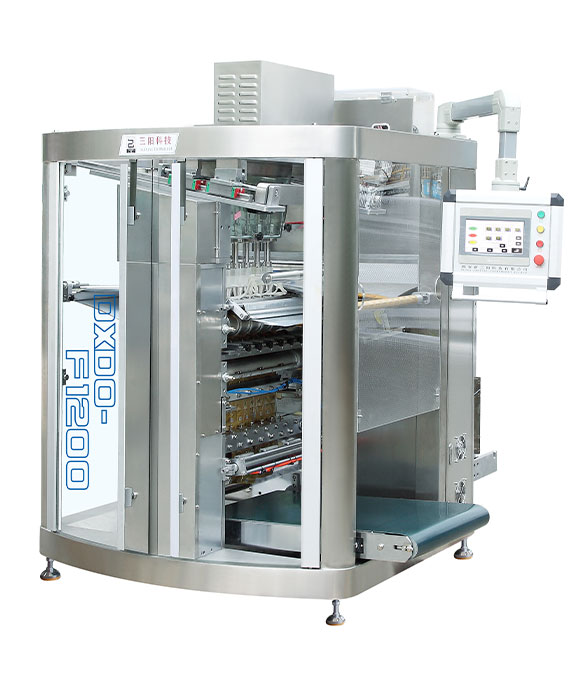
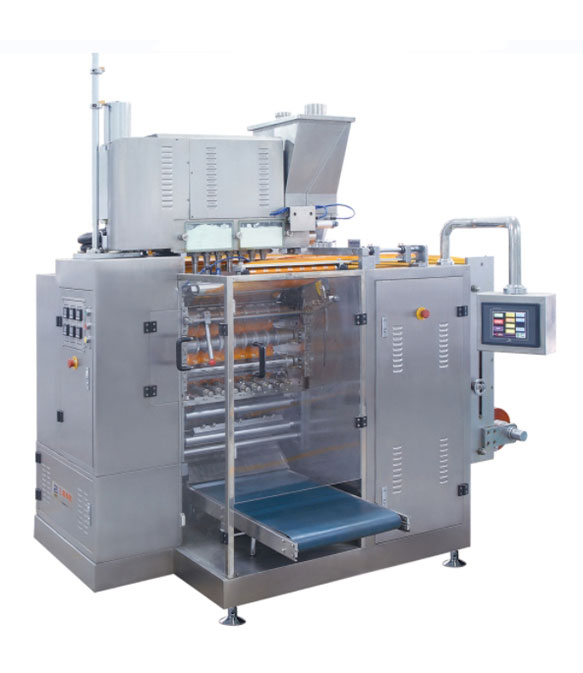
You watch the vertical packaging line run, but every few bags the horizontal seal leaks. Some pouches are wrinkled; others are cut too short. A fine dust of granules builds up around the sealing jaws. Every rejected bag means wasted film and lost product, and stopping the line to clean out compacted material costs minutes each time. On a Granular Packaging Machine, sealing failures and product jams follow predictable patterns—each pattern pointing to a specific root cause: misaligned sealing jaws, incorrect temperature or pressure, dirty sensors causing bag length drift, or product bridging that drops granules directly onto the seal interface. This guide walks through how to identify each failure by looking at the bag itself, how to confirm the cause with simple on‑line tests, and the adjustments that restore clean sealing and consistent bag length without tearing down the machine.
The appearance of the faulty bag reveals the root cause before you adjust any settings.
Missing seal sections or air leaks—seal looks incomplete, with sections that didn’t bond. The film is intact, but the heat seal has gaps. This points to misaligned sealing jaws or inconsistent jaw pressure across the width. Alignment issues between the sealing jaws can cause improper sealing. Check for any misalignment and adjust the jaws accordingly. Ensure the sealing pressure is appropriate to create a secure seal. If the temperature meter reads setpoint but the seal is cold, check whether the temperature control circuit is connected incorrectly or the thermocouple has failed.
Wrinkled bag—the film is sealed, but the bag has folds or gathers at the seal line. The film puckers around the seal area, creating weak points that can burst during handling. This usually means the film tension is too low, or the sealing jaws are closing before the film has fully settled into the forming tube. Inconsistent web tension or slippage affects bag quality. Check that tension rollers are properly adjusted and that the film is not binding on the unwind stand.
Bag length variation—bag lengths vary from cycle to cycle. The machine uses a photoelectric sensor to read registration marks on the film. If the sensor is dirty, misaimed, or the sensitivity is not adjusted properly, the cut length drifts. Also check whether the proximity switch has swept the positioning mark during the conveying process of the packaging film. A dirty lens or a mark that falls outside the sensor‘s detection window will cause erratic bag length.
Product trapped inside the seal—you see granules embedded in the seal line, or the machine stops with a crunch noise. Material bridges in the forming tube or is released too late, falling into the closing jaws. This is one of the most damaging failures because it compresses hard particles into the seal interface, creating leaks and damaging the jaws themselves.
Most seal complaints trace back to the sealing mechanism itself. For a Granular Packaging Machine running 40–60 cycles per minute, the jaws must be parallel and the temperature uniform across the sealing surface. Begin with the contact surface of the sealing roller. If the sealing mold of the equipment is not aligned during sealing and the contact surface is not flat, adjust the flatness of the contact surface of the sealing roller. Use A4 paper to check if the seal is aligned and whether the texture depth is consistent. After adjusting flatness, verify the sealing temperature. If the temperature does not reach the sealing temperature, increase the setpoint in 5°C increments until the seal holds. If the temperature meter reads setpoint but the seal is cold, check the temperature control circuit for incorrect wiring and the thermocouple for proper installation. If the horizontal sealing temperature control meter is damaged, replace it.
Bag length variation is the most frustrating intermittent failure because it can appear, disappear, and reappear without obvious cause. On the DXDO‑K900F, pouch length is adjustable from 50 to 150 mm. When bags drift, start with the photoelectric eye. A dust layer on the sensor lens or a registration mark that falls outside the detection window will cause inconsistent cutting. Clean the photoelectric sensor with a soft cloth. Confirm the sensor lens is free of dust or granule debris that could block its ability to read marks. Adjust the sensitivity so the sensor reliably sees the registration mark but ignores background noise. Also inspect the film itself—if the film supplier changed the opacity or print contrast of the registration marks, the sensor may need recalibration or a different roll of packaging film may be required. If a proximity switch is used, check whether it has swept the positioning mark during the conveying process and whether it is blocked by other objects.
When you open the sealing jaws and find granules trapped between the seal bars, the root cause is almost always timing mismatch between filling and sealing. The filler drops the dose too late, and the jaws close on product instead of film. Even a small granule stuck in the serrations can prevent the jaws from closing fully on the next cycle, causing sealing jaw jam fixes to fail repeatedly. Adjust the filling timing so that the product lands completely inside the bag before the horizontal jaws begin their closing stroke. Prevent overfilling—if the dose is too large for the bag size, granules will overflow into the seal area. For sticky or moisture‑sensitive materials, pre‑dry granules or add anti‑caking agents to improve flow. If granules consistently bridge in the forming tube, a different tube geometry or a vibratory assist feeder may be needed. After clearing a jam, inspect the jaw serrations for embedded material; even a single hardened granule can prevent full closure, starting the cycle of failures over again. The DXDO‑K900F uses five‑axis servo synchronous drive technology to ensure accurate positioning of each actuator, which helps maintain stable timing even during long runs—but correct setup of fill‑to‑seal coordination still requires operator attention.
| Failure Pattern | Most Likely Cause | First Check | Corrective Action |
|---|---|---|---|
| Missing seal sections | Misaligned sealing jaws | A4 paper test across full jaw width | Adjust jaw parallelism; balance sealing pressure |
| Wrinkled bag | Low film tension or jaw timing off | Observe film path; check dancer roller | Increase tension; adjust jaw closing timing |
| Bags drift in length | Dirty or mis‑aimed photoelectric sensor | Inspect sensor lens; check registration marks | Clean lens; adjust sensitivity; replace film roll |
| Bags drift in length (no photo sensor) | Proximity switch not detecting positioning mark | Check switch blockage; verify mark position | Clear obstruction; realign switch |
| Granules in seal / jaw jamming | Fill‑to‑seal timing mismatch | Observe fill drop relative to jaw movement | Delay fill release; reduce fill volume |
| Consistent seal leak after cleaning | Worn or damaged heating element | Measure actual jaw temperature with pyrometer | Replace heater band or thermocouple |
Q: Why does my sealing temperature read 150°C on the controller, but the seal still won’t hold? A: The controller reads the thermocouple in the heater block, not the actual jaw surface temperature. At high cycle rates, the jaws lose heat between cycles faster than the heater can recover. Use a contact pyrometer directly on the jaw surface during production. If the actual temperature is 10–15°C below setpoint, increase the setpoint accordingly or slow the machine speed to allow more jaw contact time.
Q: How often should I replace heating elements on a high‑speed granule packaging machine? A: For machines running 8‑hour shifts, inspect heater bands and thermocouples every 2,000 operating hours. Replace immediately if the seal becomes weak even after temperature adjustment, if the temperature reading fluctuates more than ±5°C at steady speed, or if the heater band shows visible oxidation, cracking, or discoloration.
Q: Can I use the same sealing temperature for all film types? A: No. PET/AL/PE laminates require higher sealing temperatures (typically 180–200°C) than PET/PE or NY/PE structures (160–180°C). Plain PE films may seal at 120–150°C. Always refer to the film manufacturer’s recommended sealing temperature range. The DXDO‑K900F is compatible with PET/AL/PE, PET/PE, NY/AL/PE, and NY/PE structures, but each requires its own temperature profile.
Q: What should I do if the machine stops with a “no film” alarm but there is plenty of film on the unwind? A: The film end sensor may be blocked by dust, or the film may have slipped off the dancer roller path. Clean the sensor lens. Check that the film is threaded correctly through all rollers and that the dancer arm moves freely. Also verify that the film core diameter matches the machine’s specifications (Φ75 mm core).
Q: My bags seal well, but the cut is uneven or the batch number is missing. Where should I look? A: Uneven cutting points to dull or misaligned cutoff blades. Check the blade edge for nicks or wear and replace if dull. If the batch number is missing, inspect the hot stamp printer ribbon—if the ribbon is depleted or the print head temperature is too low, the impression will be faint or absent. Adjust print head temperature upward in 5°C increments until the imprint is clear but not smudged.
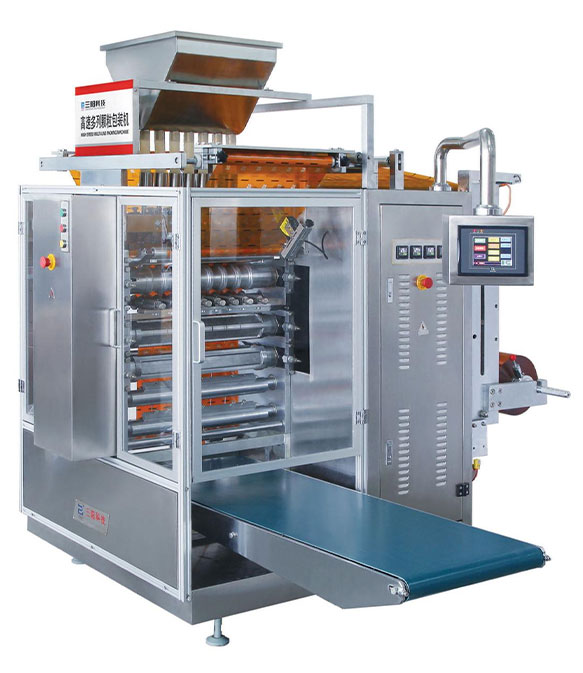
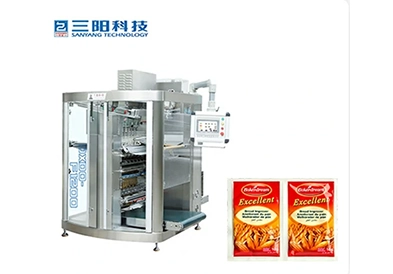
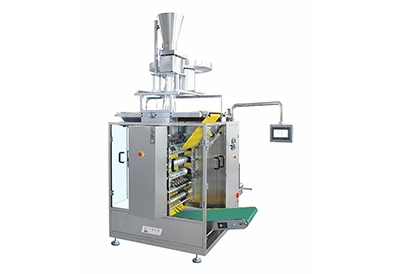
When packaging consistency is critical to throughput and waste reduction, the engineering of the Granular Packaging Machine determines how reliably it runs shift after shift. Sanyang manufactures the DXDO‑K900F Vertical Granule Packing Machine for high‑speed sachet packaging of granulated products—Chinese medicine, sugar, salt, tea, spices, capsules, MSG, seeds, desiccant, and other fine particulates. The machine uses five‑axis servo synchronous drive technology to ensure accurate positioning of each actuator, producing consistent bag length and seal quality across extended production runs. The production speed is up to 60 cuts per minute, with touchscreen PLC control, stepless adjustable packaging speed, and automatic bag making, metering, filling, sealing, cutting, counting, and batch number printing.
Key specifications include pouch length adjustable from 50 to 150 mm, pouch width from 40 to 105 mm, filling capacity of 0.5–60 ml per bag, maximum film width of 930 mm, and total power of 12 kW. The machine accepts multiple film structures—PET/AL/PE, PET/PE, NY/AL/PE, and NY/PE—making it suitable for applications in food, pharmaceutical, chemical, medical, cosmetic, and agricultural industries. Sanyang provides technical support and operator training to help facilities achieve consistent packaging quality from the first production run.
→ Request a quote from Sanyang for the DXDO‑K900F Vertical Granule Packing Machine — Share your target bag size (length × width), desired production speed (cuts per minute), packaging material (film structure), and product type (granule size, moisture content). Their technical team will recommend the right configuration and provide sealing optimization guidance for your specific application.

 English
 Pусский
 Español
 عربي
عربي .jpg)