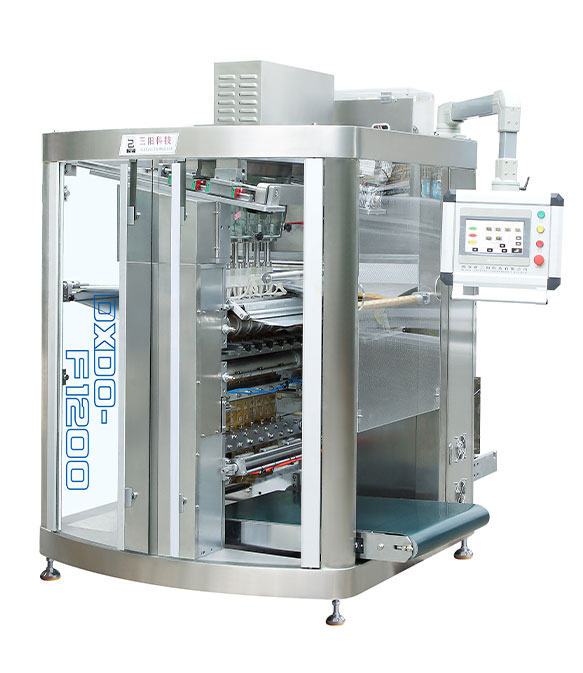
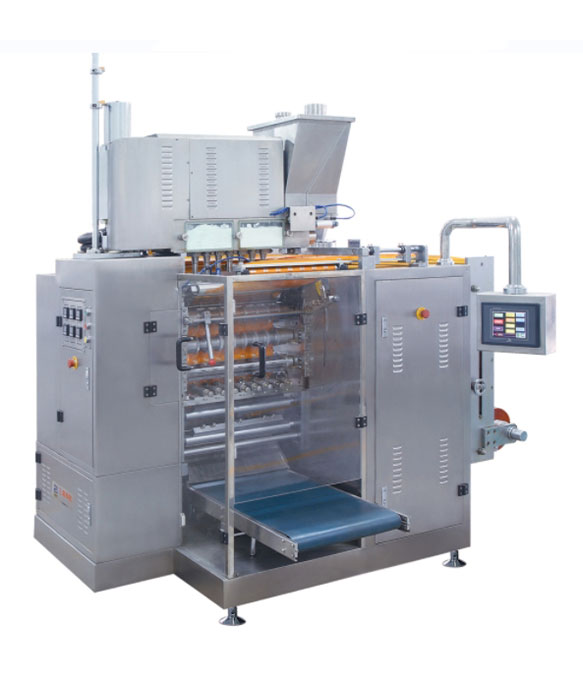
You're running a line for water-pill granules or herbal extracts, and the path from bulk material to a sealed sachet inside a printed carton involves multiple machines, multiple handoffs, and multiple points where product can spill, sachets can jam, or batch codes can go missing. A Granular Packaging Machine integrated into an automatic production line closes that gap by forming the pouch, dosing the granules, sealing the edges, and feeding the finished sachet into a cartoning station without an operator touching the product. This article explains how the forming and filling sequence works, where GMP compliance enters the design, and what to verify when you're specifying a granule line for food or nutraceutical packaging.
A standalone sachet machine produces finished pouches into a collection bin. Someone has to move that bin to the cartoner, load the cartoner infeed, and manage the buffer between the two machines. Every handoff is a chance for sachets to scatter, for batch codes to be misread, or for the cartoner to starve while the sachet machine keeps running.
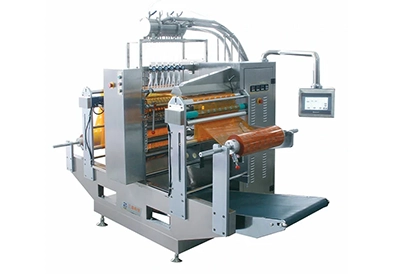
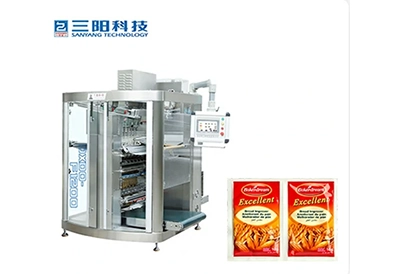
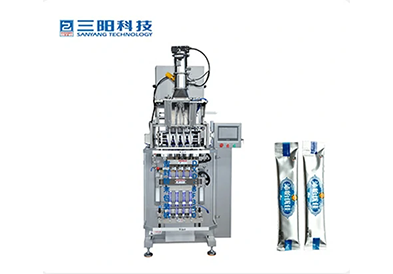
An integrated line removes those handoffs. The small-pouch packaging machine, the pouch sorting conveyor, the up-opened cover box machine, and the detection and rejection machine work as one system. The sachets move from the sealing station to the cartoner on a conveyor, and the cartoner receives them in a continuous stream. That continuity is what allows the line to run at a steady output instead of surging and stalling.
The line completes a sequence that includes automatic vacuum loading, bag making, filling, batch number printing, cutting and tearing, punching, bag unloading, bag picking and sorting, online detection, automatic counting and stacking, boxing, finished bag boxing, instruction manual boxing, and product output. Each of those steps is linked to the next, so the finished carton comes off the end of the line with the sachets and the leaflet already inside.
The core sachet machine in the DXD-WL900E line operates at 60 times per minute, with a pouch length range of 50–120mm and a pouch width range of 50–105mm. The filling capacity is 1–40ml, which covers the dose range for water-pill granules and similar free-flowing particulate products.
The four-side sealing format produces a flat, rectangular sachet with seals on all four edges. That format is stiffer than a three-side or pillow bag, which helps the sachet feed cleanly into the cartoner. The sealing temperature is controlled by an intelligent module that adapts to the film type, so the seal integrity stays consistent when you switch between laminates.
The machine accepts PET/AL/PE, PET/PE, NY/AL/PE, and NY/PE laminates. The aluminum-containing structures provide moisture and oxygen barrier for hygroscopic granules. The clear structures are used when product visibility or cost is the primary concern. The maximum film width is 900mm, and the maximum film diameter is Φ300mm.
| Parameter | Sachet Machine (in DXD-WL900E Line) | Cartoner (SZH-60) |
|---|---|---|
| Speed | 60 times/min (depends on pouch size & material) | 20–60 boxes/min |
| Pouch length | 50–120mm (adjustable) | — |
| Pouch width | 50–105mm | — |
| Filling capacity | 1–40ml | — |
| Box size range | — | 85×37×40mm to 180×60×65mm |
| Film material | PET/AL/PE, PET/PE, NY/AL/PE, NY/PE | — |
| Total power | 12kW | 3.5kW |
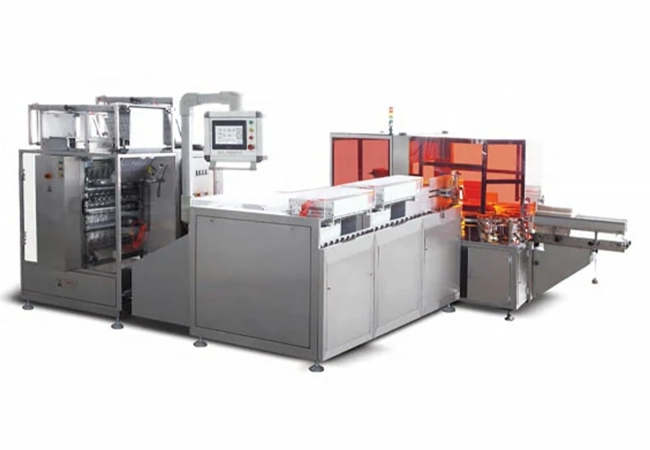
The line fully complies with GMP production standards. That compliance shows up in the materials that contact the product and the surfaces that need cleaning between batches. Stainless steel contact parts and smooth, accessible surfaces reduce the risk of product buildup and make the cleaning routine shorter.
For food and nutraceutical production, GMP compliance isn't just a regulatory checkbox—it's a requirement that customers and auditors will ask about. A line that meets GMP standards gives you documentation and construction details that support your own compliance program.
A GMP-compliant design also considers how the machine behaves during product changeover. The ability to clean and verify the product path between batches determines how quickly you can switch from one granule product to another without cross-contamination risk. The line's modular station layout and accessible contact surfaces support that changeover discipline.
After sealing and cutting, the sachets move onto a pouch sorting conveyor. The conveyor aligns the sachets and presents them to the cartoner in a controlled pattern. Before the sachets enter the cartoner, an online detection system checks weight or presence. Sachets that fail the check are rejected, so only compliant sachets reach the carton.
The detection and rejection function is what protects the finished carton from containing a missing or underfilled sachet. In a line running at 60 sachets per minute, manual inspection isn't feasible—the automated check is the quality gate.
The cartoner forms the box from a flat blank, opens the cover, inserts the sachets, folds and closes the carton, and adds the instruction manual. The cartoner runs at 20–60 boxes per minute, with a box size range of 85×37×40mm to 180×60×65mm. The leaflet size range is 80–170mm wide by 125–260mm long unfolded, or 80–170mm by 30–60mm folded.
A Granular Packaging Machine integrated into a line like the DXD-WL900E from Chinapack Machinery doesn't just fill sachets—it delivers a finished, cartoned product. The line's ability to match the sachet output to the cartoner input is what determines the overall throughput.
The line is designed for water-pill granules and similar free-flowing particulate materials. The dosing range of 1–40ml suits small-dose sachets for nutraceuticals, herbal extracts, and food ingredients. The four-side sealed pouch format is standard for these applications because it presents a clean, rectangular sachet that stacks neatly in a carton.
The sachet machine can handle other granular products within the same dose and pouch size range, but the product's flow characteristics affect the dosing consistency. Free-flowing granules dose more predictably than sticky or cohesive materials. If your product has a tendency to clump, test it on the machine before committing to a full line configuration.
The line's GMP compliance and food-grade contact materials make it suitable for food and nutraceutical applications where hygiene and documentation matter. The inline cartoning step adds a retail-ready package format, which is useful for products that ship to pharmacies, health food stores, or e-commerce fulfillment centers.
Check that your dose volume falls within the 1–40ml filling range and that your desired sachet dimensions fit within the 50–120mm length and 50–105mm width range. If your dose is near the top of the range, verify that the film structure and seal width can contain the product without bulging or stressing the seals.
The cartoner accepts boxes from 85×37×40mm to 180×60×65mm. Measure your finished carton dimensions against that range. If your carton falls outside the range, the cartoner's tooling would need to be changed or a different cartoner model selected.
The line accepts PET/AL/PE, PET/PE, NY/AL/PE, and NY/PE. For hygroscopic water-pill granules, an aluminum-containing structure like PET/AL/PE or NY/AL/PE provides the moisture barrier. For products where cost or clarity is the priority, PET/PE or NY/PE may be adequate. Test the film on the machine to confirm seal integrity and runnability.
Clean the product contact surfaces at every changeover to maintain GMP compliance. Inspect the sealing jaws for wear and the cutting blades for sharpness. Check the photoelectric sensors on the sorting conveyor for dust buildup—the sensors need a clear view of the sachets to track them. Verify the cartoner's vacuum cups and folding mechanisms for wear, and check the rejection system to confirm that failed sachets are actually diverted.
The pouch length and width are adjustable within the 50–120mm and 50–105mm ranges. Changing sachet size involves adjusting the bag former and the sealing parameters. The cartoner's box size range is also adjustable within its stated limits. The changeover is a machine setting exercise, not a component replacement, but the time required depends on how far the new size is from the previous one.
Jams usually trace back to sachet alignment on the sorting conveyor. If the sachets arrive at the cartoner out of position or overlapping, the cartoner's pick-and-place mechanism can't place them cleanly. Check the sorting conveyor's guide rails and the photoelectric sensors that track sachet position. A worn conveyor belt or a misaligned guide can cause the sachets to drift.
The line is designed for automatic operation, but it needs an operator to load film, load carton blanks, replenish the leaflet magazine, and respond to alarms. The automation reduces the labor per carton, but it doesn't eliminate the need for an attentive operator who can clear jams and maintain the GMP cleaning routine.
The sachet machine uses 12kW, and the cartoner uses 3.5kW. The electrical supply is 380V 50Hz, with customization available on request. Confirm that your facility has the capacity for the combined load, including the starting current of the main motors.
A Granular Packaging Machine line should match your dose volume, sachet dimensions, carton size, and production target—not the other way around. The DXD-WL900E Water Pill Granule Sachet Filling Machine for Food Packaging from Chinapack Machinery runs at 60 sachets/min with a 1–40ml fill range, forms four-side sealed pouches from 50–120mm long and 50–105mm wide, and feeds a cartoner that handles boxes from 85×37×40mm to 180×60×65mm. The line complies with GMP production standards and automates vacuum loading, bag making, filling, sealing, detection, stacking, and cartoning. If you're specifying a granule sachet line for food, nutraceutical, or water-pill production, send us your dose, sachet size, and carton dimensions — we'll help you confirm the right line configuration before you order.

 English
 Pусский
 Español
 عربي