Have you ever watched a packaging line struggle with a cloud of cocoa powder or a stream of chili flakes that just won't stop? It’s a common sight in facilities that haven't found the right match between their product and their filler.
Choosing the wrong dosing system doesn't just create a mess; it eats into your profits through product giveaway, inconsistent weights, and endless downtime for cleaning. For many production managers, the debate often comes down to two workhorses of the industry: the screw (auger) filler and the cup (volumetric) filler. But how do you decide which one is right for your specific powder?
Let’s move beyond the marketing brochures and look at the engineering reality. We’ll break down the performance of each system based on texture, speed, and accuracy.
At their heart, both systems are volumetric—they measure by volume, not weight. However, the way they achieve this is fundamentally different.
Cup Fillers use a simple cavity (the cup) that fills with product and then releases it into a bag or container. Think of it like an ice cream scoop.
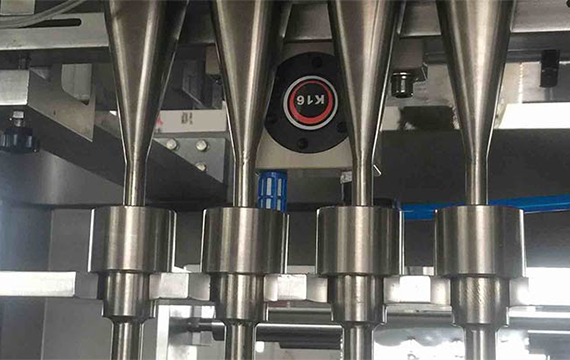
Screw (Auger) Fillers use a rotating helical screw blade inside a barrel to push product from a hopper down into a filling tube. Think of it like a drill pushing dust upwards, but in reverse.
This is the single most important factor in your decision.
The Case for Cup Fillers (Free-Flowing Products)
If your material behaves like sand or grains—think granular spices, coffee beans, sugar, or certain powdered milk—a cup filler is your most efficient and cost-effective solution. The material naturally flows into the cup under gravity.
Advantage: Extremely fast cycle speeds, simple mechanics, and lower initial investment.
The Catch: Accuracy can vary if the powder density changes. A fluffy batch will weigh less than a compacted batch, even if the volume is the same.
The Case for Screw Fillers (Difficult Powders)
This is where the auger filler shines. For products that are sticky, aerated, or don't flow easily (like flour, protein powder, or fine spices), a cup filler will leave you with voids and inconsistent fills. The auger’s forced feeding mechanism actively pulls the material down.
Advantage: Superior for a wide range of textures, from fine airy powders to denser blends. It reduces "bridging" (powder getting stuck in the hopper).
The Catch: More complex, with more parts to clean, and a higher upfront cost.
Based on feedback from packaging engineers at several medium-sized food co-packers, the speed-accuracy trade-off is where most people make mistakes.
For a free-flowing product, a cup filler running at high speed can achieve ±1-2% accuracy. That’s excellent for a 1kg bag of rice. However, for a high-value pharmaceutical or cosmetic powder (think face powder or creatine), giving away 1-2% of your product is financially disastrous.
Screw fillers generally win on precision, especially with small target weights (under 500g). Because you can control the RPM and pitch of the screw, you can achieve a "top-off" or "dribble" speed to fine-tune the final gram. Cup fillers are binary: it's either full or empty.
Which keeps your sanitation team working late?
Cup Fillers: Usually win here due to their simple mechanical design. Changing volume often involves swapping out a physical cup or adjusting a slide gate. Cleaning is straightforward because there are fewer moving parts trapping product.
Screw Fillers: Cleaning an auger is more involved. You must disassemble the screw, barrel, and tooling. However, modern designs feature "tool-less" disassembly for quick wash-downs, which narrows the gap.
If your production involves frequent flavor changes (e.g., switching from turmeric to garlic powder), the ease of the cup system is a major advantage.
Stop asking which is "best" and start asking which matches your constraints.
| Feature | Cup Filler | Screw (Auger) Filler |
|---|---|---|
| Powder Type | Free-flowing (granules, seeds, grains) | Non-free-flowing, fine, aerated, sticky |
| Target Weight | Medium to Large (>100g) | Small to Medium (1g – 5kg) |
| Speed | Very High (up to 120+ cycles/min) | High (up to 70 cycles/min typical) |
| Accuracy | Moderate (±1-2%) | High (±0.5-1%) |
| Cleaning | Easy | Moderate (requires disassembly) |
| Cost | Low to Medium | Medium to High |
How to make the final choice?
Test your powder. Run a sample on both systems. Watch for dusting and bridging.
Calculate your giveaway. If you run 10,000 bags, what is 1% of the product worth? A screw filler might pay for itself in a month.
Consider your future. Do you plan to run different types of powders later?
For consistent, high-precision needs with tricky ingredients, many operators ultimately choose a modular auger system. You can explore the technical specifications of these modular machines here to see if the torque and drive systems match your viscosity requirements.
Regardless of which technology you choose, avoid these two mistakes:
Ignoring the "Rattle" Effect: Aggressive vibration on a cup filler can settle the powder, causing overfills. Conversely, too little vibration leaves air pockets.
Wrong Pitch on Auger: Using a "short pitch" screw for a light, fluffy powder will choke the system. You need a "long pitch" screw for rapid conveyance.
Don't buy a filler based on a price sheet. Buy it based on a test. Reach out to machine builders who offer material analysis. They will run your specific powder—be it matcha, chili powder, or detergent—through both a cup and a screw filler to measure dust, accuracy, and speed.
If you are dealing with challenging, sticky, or fine pharmaceutical powders that require dust-tight operations and high hygiene standards, solutions exist that combine the best of both worlds. You can check modular configurations designed for tricky powders here.
Remember, the right machine is the one that runs quietly, accurately, and cleanly for 10,000 cycles straight. Don't let a beautiful brochure fool you; let the physics of your powder be the final judge.

 English
 Pусский
 Español
 عربي
عربي .jpg)