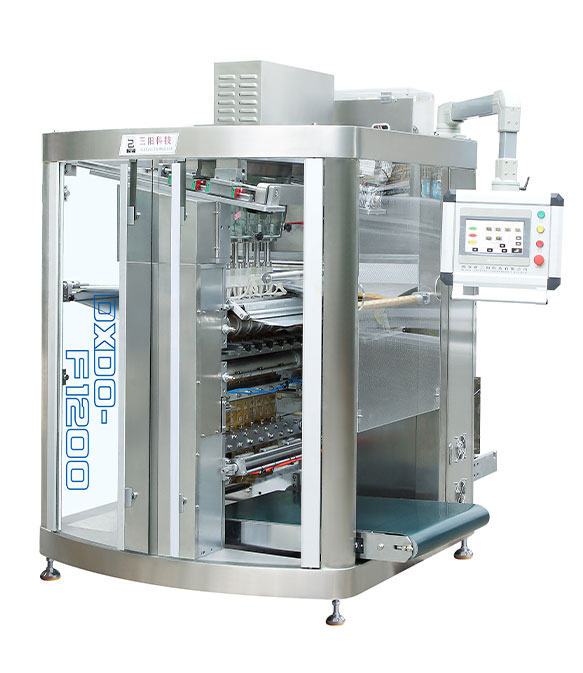
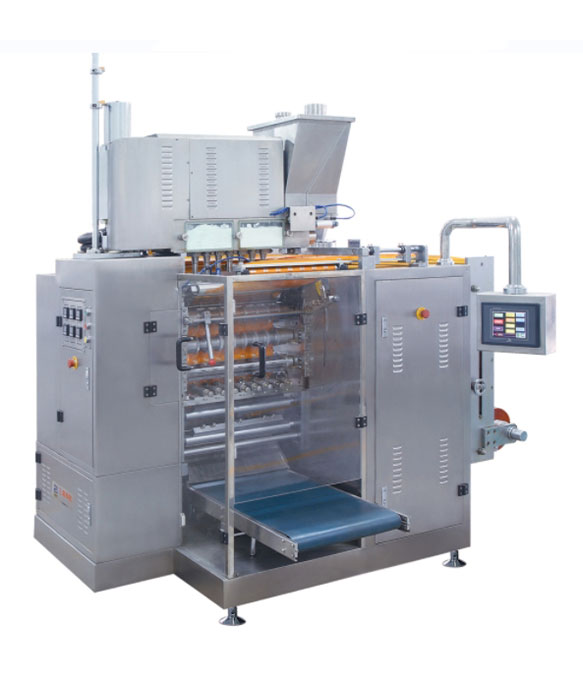
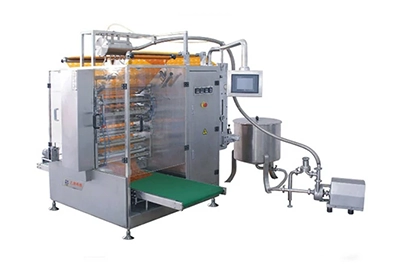
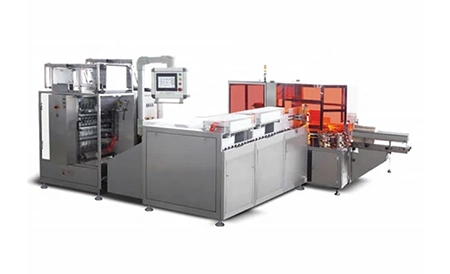
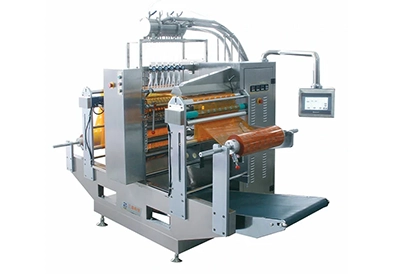
Yes—when the feeding system uses a screw to meter the powder and the sealing jaw closes on a settled fill. A Powder Packaging Machine like the DXD-BF80C combines a screw-type feeder with a back-sealing jaw that runs at 30–70 bags per minute across a 2–50ml fill range. This article explains how the screw feeder meters fine powders, what the PLC control contributes to the sealing cycle, and what to verify when you're matching a back-sealing powder line to your production.
The DXD-BF80C uses a screw-type feeding system for powder measurement. The screw rotates at a controlled speed and delivers the powder into the pouch through a vertical tube. The fill volume is set by adjusting the screw speed and the fill time, which are both managed by the PLC.
That screw design is what allows the machine to handle fine powders like coffee, detergent powder, and agricultural chemicals without the clumping or bridging that can occur in gravity-fed systems. The screw continuously moves the powder forward, so the flow stays consistent from pouch to pouch.
The feeding system and the machine shell are made of full stainless steel, which provides high corrosion resistance and easy cleaning. The construction is GMP-compliant, making it suitable for pharmacy and food applications where hygiene is critical. A clean contact path also reduces the risk of powder buildup that could affect fill accuracy over a long production run.
The DXD-BF80C uses a PLC programmable control system with an English and Chinese display screen. The PLC manages the entire sequence: it signals the screw feeder to dispense the powder, advances the film to the sealing position, closes the back-sealing jaws, cuts the pouch, and increments the counter.
That coordination is what makes the machine a single continuous process rather than a series of separate stations. The operator sets the parameters on the touch screen, and the PLC maintains the timing across the production run.
The machine includes a photoelectric tracking system with a two-way compensation function. That system reads the registration marks on the printed film and adjusts the film position so the print stays correctly aligned on both faces of the pouch.
For printed pouches, that tracking is what keeps the graphics centered and the tear notch in the right position. Without the compensation, the print would drift as the film roll diameter changes, and the finished pouches would have off-center graphics.
| Parameter | DXD-BF80C Specification |
|---|---|
| Pouch length | 50–120mm (adjustable) |
| Pouch width | 20–80mm |
| Packing speed | 30–70 times/min |
| Filling capacity | 2–50ml/bag |
| Cutting options | Flat cutting with tear notch, fracture line cutting, saw-tooth cutting |
| Applicable film | PET/AL/PE, PET/PE, NY/AL/PE, NY/PE, aluminized complex film |
| Electric source | 250V 50Hz (customizable) |
| Total power | 900W |
| G.W. | 250kg |
| Package size | 800×700×1500mm |
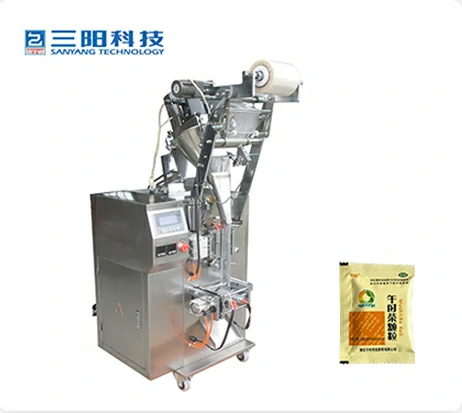
A Powder Packaging Machine in the DXD-BF80C configuration is used in pharmacy, food, daily chemical, and agriculture industries. It packs coffee, detergent powder, and similar fine powders into small back-sealed pouches.
The back-sealing format—where the film is folded and sealed along the back—is a common choice for small powder sachets. It uses a single film web, which simplifies the machine and reduces the film inventory compared to a three-side or four-side seal format.
The 30–70 bags per minute output covers the production volumes of a small-to-mid-size operation. For a coffee roaster or a detergent brand that sells single-serve sachets, that throughput matches the demand without requiring a high-speed line.
The filling capacity is 2–50ml per bag. Match that range to your product dose. A single-serve coffee sachet might run 5–10ml; a detergent sample might run 20–30ml. If your dose exceeds 50ml, a different model or a different feeding system would be required.
The machine accepts PET/AL/PE, PET/PE, NY/AL/PE, NY/PE, and aluminized complex films. For coffee, an aluminum-containing structure like PET/AL/PE provides the moisture and oxygen barrier that keeps the aroma fresh. For detergent powder, a PET/PE structure may be sufficient. The film choice depends on the product's sensitivity to moisture, oxygen, and light.
The machine offers flat cutting with a tear notch, fracture line cutting, and saw-tooth cutting. A tear notch is the standard for single-serve sachets that the consumer opens by hand. A fracture line is used where the sachet needs to be torn along a defined line. A saw-tooth cut provides a decorative edge. The cutting style is specified at the ordering stage.
A screw feeder uses a rotating screw to move powder continuously into the pouch. A measuring cup uses a volumetric cup that fills and then dumps the powder. The screw feeder is better suited to fine powders that can bridge or clump, because the screw action keeps the powder moving. The measuring cup works well for free-flowing granules.
Yes. The photoelectric tracking system reads the registration marks and the two-way compensation keeps the print aligned on both faces. That capability is what allows the machine to produce branded pouches with centered graphics and correctly positioned tear notches.
The machine uses 900W total power at 250V 50Hz, with customization available for different voltages. The low power draw reflects the fact that the machine is a packaging line, not a processing line—the motor loads are modest compared to an extruder or a large forming press.
Inspect the sealing jaw surface for powder buildup or coating wear during scheduled maintenance. A contaminated jaw transfers uneven heat and produces a weak seal. Clean the screw feeder and the filling tube to prevent powder caking, and check the photoelectric sensor lens for dust that could affect registration tracking.
A Powder Packaging Machine in the DXD-BF80C configuration should match your fill volume, film structure, and output target—not the other way around. The DXD-BF80C Automatic Powder Packaging Machine from Chinapack Machinery runs at 30–70 bags/min with a 2–50ml fill range, uses a screw-type powder feeder and PLC control with photoelectric tracking and two-way compensation, and handles PET/AL/PE, PET/PE, NY/AL/PE, and NY/PE films in a GMP-compliant stainless steel construction. If you're specifying a back-sealing powder line for coffee, detergent, or agricultural products, send us your fill volume, film, and output target — we'll help you confirm the right configuration before you order.

 English
 Pусский
 Español
 عربي