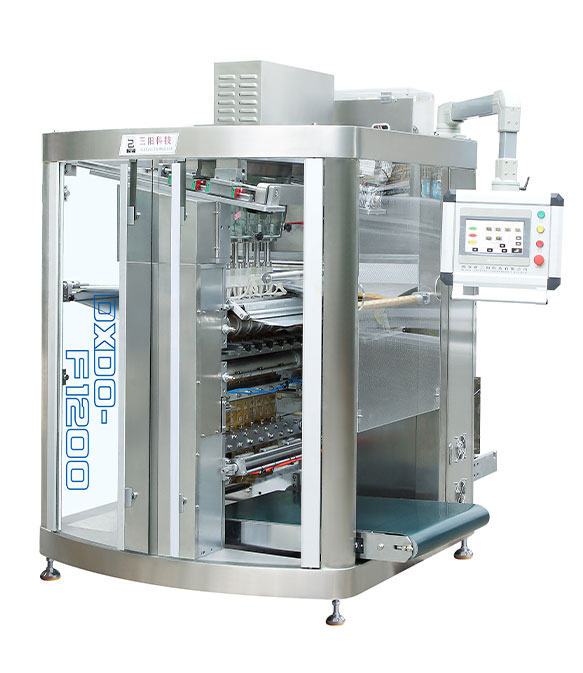
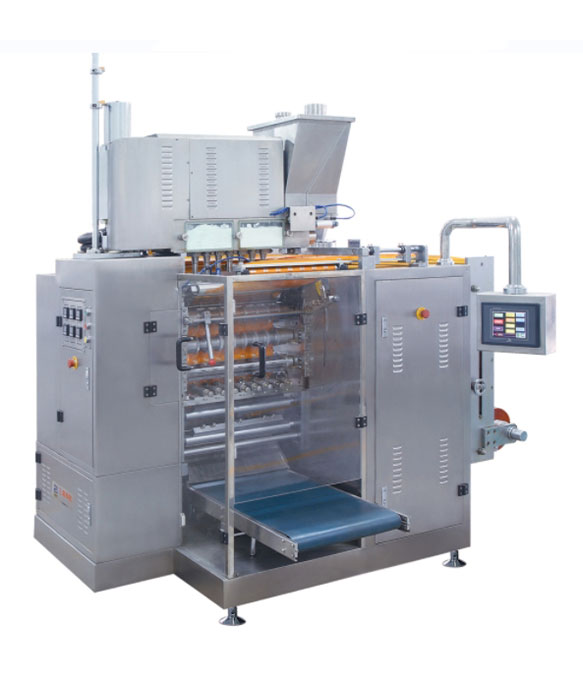
You're packaging single-serve soy sauce, a water-based medicine, or a frozen pop stick, and the sachet has to hold its contents without a single pinhole leak. A Liquid Packaging Machine seals four sides by running the film through a pair of precision heat-sealing rollers that weld the top, bottom, and both side edges in one continuous motion. The DXDO-Y900E from Chinapack Machinery runs this four-side sealing architecture across 30–60 cycles per minute with a 1–100ml fill range, using per-lane solenoid valves to keep every sachet in the web filled to the same volume. This article explains how the four-side seal forms, how the metering system delivers liquid without drips or variation, and what to verify when you're matching a multi-lane sachet line to your product.
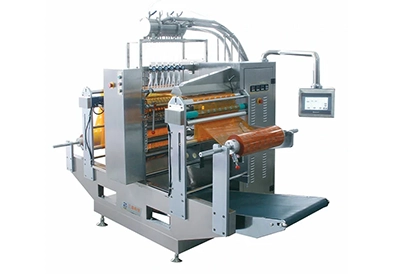
A conventional sachet machine uses a stamping jaw that opens and closes on the film. The DXDO-Y900E uses a high-precision integral rolling heat-sealing roller as the sealing mold. The roller rotates continuously, pressing the film layers together as the web moves through the nip. That rolling action produces a smooth, uniform seal across the full width of every sachet, with a bag shape that sits flat rather than puckering at the edges.
The sealing temperature is controlled automatically, with a precision of ±1°C . That tight window matters because liquid sachets are sensitive to heat: too cool and the PE layer doesn't fully melt, leaving a weak seam; too hot and the film stretches or the liquid inside begins to boil, creating a bubble that prevents a clean bond.
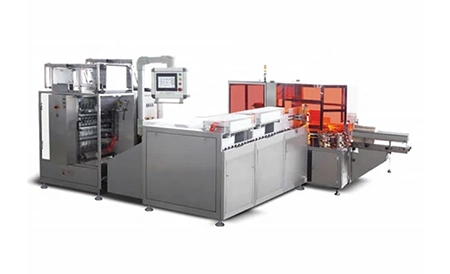
The machine completes the entire sachet-forming sequence in a single pass: longitudinal sealing, longitudinal cutting, transverse sealing, filling, coding, easy-tear notch cutting, dotted-line cutting, and transverse cutting to finished bag output. The four-side seal is the result of the longitudinal seal forming the side edges and the transverse seal closing the top and bottom. Because the filling happens between the two transverse seals, the liquid is enclosed by four welded edges before the sachet is cut free.
| Parameter | DXDO-Y900E Specification |
|---|---|
| Pouch length | 50–150mm (adjustable) |
| Pouch width | 32–105mm |
| Packing speed | 30–60 cycles/min |
| Filling capacity | 1–100ml |
| Max film width | 900mm |
| Film types | PET/AL/PE, PET/PE, NY/AL/PE, NY/PE |
| Drive system | Five-axis servo synchronous |
| Control | PLC + touch-screen HMI |
| Liquid pump | Centrifugal, stainless steel |
| Total power | 15kW |
| Machine weight | 1,500kg |
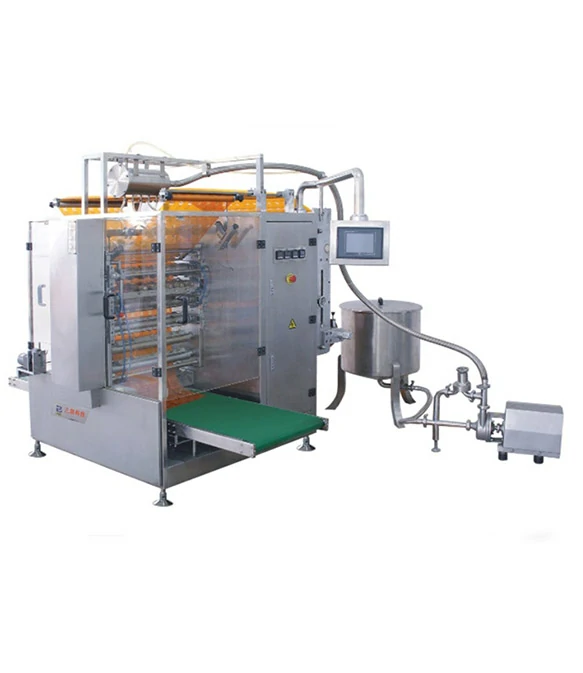
Liquid filling accuracy depends on how consistently each lane receives its dose. The DXDO-Y900E uses a centrifugal liquid pump designed specifically for liquid materials, paired with a high-precision solenoid valve on each lane. Every valve has its own instantaneous large-flow voltage stabilizing device, so each row of bags can be filled independently and adjusted with fine-tuning.
That per-lane independence is what keeps a multi-lane web consistent. If lane three runs slightly lean because its nozzle is partially restricted, the operator can adjust that lane's valve without touching the other lanes. The pump body is stainless steel, which keeps the liquid contact path clean and resists corrosion from acidic products like vinegar or medicinal liquids.
The film feed, sealing roller rotation, filling valve timing, and cutting action are all coordinated by a five-axis servo synchronous drive under PLC control. The servo system positions each actuator electronically, so the fill happens at the exact moment the sachet pocket is open and aligned under the nozzle, and the seal closes before the web advances to the next station.
Without that synchronization, a high-speed line would suffer from fill-timing drift: the valve would open late on some cycles and early on others, and the fill volume would vary across the web. The servo coordination eliminates that drift by tying every motion to the same master position signal.
The DXDO-Y900E handles PET/AL/PE, PET/PE, NY/AL/PE, and NY/PE laminates. The aluminum-containing structures provide the moisture and light barrier that water-based medicines and food liquids require. The clear structures are used where product visibility or cost is the primary concern.
The sealing temperature control adapts to the film type through the HMI. Each laminate has a different seal-initiation temperature, and the ±1°C control window lets the operator dial in the right setting without scorching the film or leaving a weak bond. The machine is described as suitable for packaging films from both domestic and international suppliers, which gives the production planner flexibility in sourcing.
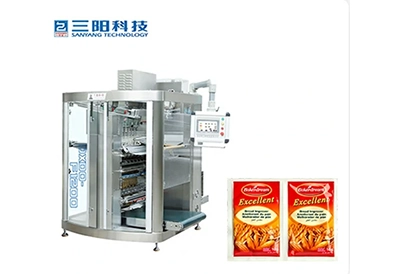
A Liquid Packaging Machine in the DXDO-Y900E configuration is built for popsicles, soy sauce, vinegar, alcohol, medicines (water-based), and chemical agents (water-based) . Those products share two characteristics: they flow through a pump without clogging, and they need a sealed sachet that survives handling without leaking.
The 30–60 cycles per minute output depends on the number of lanes and the fill volume. A multi-lane configuration produces several sachets per cycle, so the effective output scales with the lane count. That throughput suits a production line that supplies single-serve condiment packs, frozen treat tubes, or pharmaceutical unit doses.
The standard configuration produces a flat-cut sachet with an easy-tear notch. The machine can be fitted with a dotted-line knife, a flat knife, or a special-shaped knife for different opening styles, and the alarm system can be configured to match the plant's requirements. Those options let the same platform serve a product line that includes both tear-open condiment packs and twist-open popsicle tubes.
The DXDO-Y900E covers 1–100ml. A single-serve soy sauce pack typically runs in the 5–15ml range; a popsicle tube or a liquid medicine dose may run higher. Confirm that your target volume sits within the range and that the pump and valve combination can deliver it at the required cycle rate. If the volume is near the top of the range, verify that the film structure and seal width can contain the liquid without bulging.
Match the film to the product's barrier requirement. For a water-based medicine that needs light protection, an aluminum-containing laminate like PET/AL/PE or NY/AL/PE is the appropriate choice. For a clear vinegar or alcohol sachet where visibility matters, PET/PE or NY/PE may be sufficient. Test the film on the machine to confirm seal strength and runnability before committing to a production order.
Inspect the roller surface for wear or polymer buildup. A contaminated roller transfers uneven heat and produces weak seams. Check the sealing temperature against a calibrated reference and verify that the ±1°C control is holding across the roller width. Clean the filling nozzles and solenoid valves to prevent dried product from affecting the dose volume.
The machine runs on 380V 50Hz with a total power of 15kW. Confirm the facility's electrical capacity for the connected load. The centrifugal pump and the servo drives draw the majority of that power, so the supply should be stable and sized for the starting current of the main motors.
A four-side seal encloses the sachet on all four edges, so there is no folded edge that can develop a pinhole or a weak crease. For liquids that can migrate through a folded seam under pressure, the four-side weld provides a more reliable barrier. The flat, welded perimeter also gives the sachet a more rigid shape that stands up in a carton or a display box.
The per-lane solenoid valves are independently adjustable. That means the operator can set a different fill volume for lane one than lane two, if the production plan calls for mixed volumes on the same web. In practice, most runs use the same volume across all lanes, but the capability exists for specialty orders.
Leakage at the seal usually comes from three causes: liquid contamination in the seal zone during filling, insufficient sealing temperature, or a contaminated sealing roller. If the fill nozzle drips or splashes onto the seal area, the heat-seal roller cannot bond through the liquid layer. Check the fill timing, the nozzle condition, and the sealing temperature before assuming the film is at fault.
The DXDO-Y900E and DXDO-Y900EW share the same four-side sealing architecture and the same 30–60 cycles per minute output range. The suffix difference reflects a configuration variation in the series, such as the film handling or the cutting arrangement. Confirm the specific model and its options against your product and film requirements before finalizing the order.
A Liquid Packaging Machine should match your fill volume, film structure, and target output—not the other way around. The DXDO-Y900E from Chinapack Machinery forms four-side sealed sachets at 30–60 cycles/min with a 1–100ml fill range, using stainless steel centrifugal pumps and per-lane solenoid valves for independent dosing control. The five-axis servo drive and ±1°C sealing temperature control handle PET/AL/PE, PET/PE, NY/AL/PE, and NY/PE films across a 900mm maximum web width. If you're specifying a sachet line for condiments, liquid medicines, or frozen popsicles, send us your fill volume and film requirement — we'll help you confirm the right configuration before you order.

 English
 Pусский
 Español
 عربي