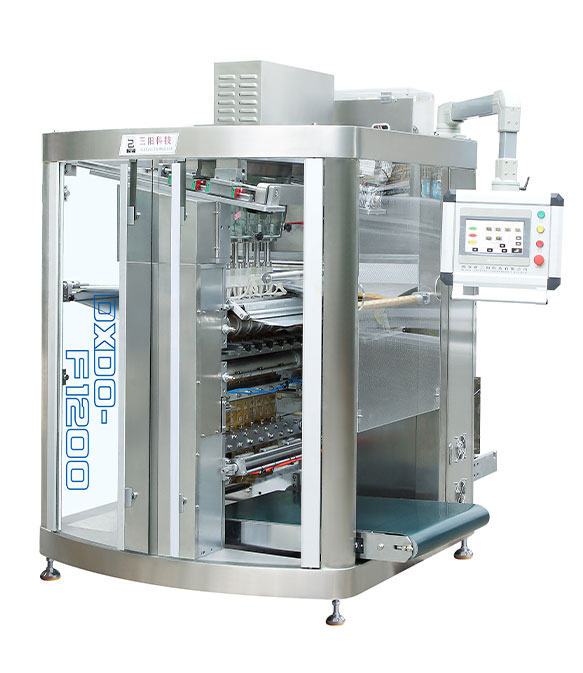
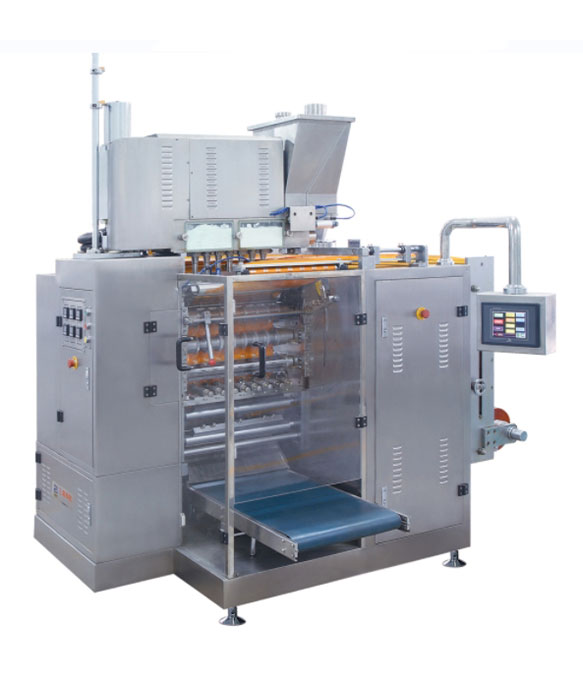
A Granular Packaging Machine does two jobs at the same time: it divides a bulk supply of small solids into precise doses, and it seals each dose into a pouch that protects it. You'll see how the DXDO-W900E lines up metering, film, and lane count, and where the practical limits sit.
The fill range is 1–50ml. That span covers the small-dose sachet format the machine is built around, where a single pouch holds a measured quantity of water pills or similar small solids rather than a bulk pour. The lower end of the range is where metering accuracy matters most, because a small absolute error is a large percentage error in a 1ml dose.
Lane count is 4–6, and each lane receives its own dose from the metering system. More lanes mean more doses per cycle, so the metering system has to divide the bulk supply evenly across the web. The page lists a PLC and frequency changer as the control platform, which is what allows the operator to adjust cycle timing so each lane fills consistently rather than favoring the lanes nearest the feed.
The metering section and the sealing section are separate mechanisms, but they meet at the same point in the cycle. A dose drops into the formed pouch, the web indexes forward, and the sealing jaws close on the film. If the drop and the index aren't synchronized, the product lands on the seal area instead of inside the pouch—and a contaminated seal is a leak waiting to happen.
The DXDO-W900E uses four-side roller heat sealing, which means the seal is formed on all four edges of each pouch rather than on two sides plus a fold. For a granular product, that closed perimeter matters: it keeps small solids away from the open edges and gives the pouch a defined shape that stacks predictably in a carton.
A pillow-style pouch leaves two edges as folds, and small granules can migrate into the fold during handling. A four-side seal closes the perimeter on all edges, so the product stays in the central chamber. That's a Granular Packaging Machine design choice that follows the product type, not a cosmetic preference.
The rated speed is 30–40 bags/min across 4–6 lanes, and that range is the honest answer to how fast the machine runs. It isn't a fixed figure the line hits regardless of setup—it's a band, and where a given production run lands inside it depends on three variables that interact.
The first is dose size. A 1ml dose drops and settles faster than a 50ml dose, so the small-dose end of the range supports the upper end of the speed band. The second is film structure. A PET/PE laminate seals at a lower temperature and shorter dwell than a PET/AL/PE structure with an aluminum core, so the thinner film allows more cycles per minute. The third is lane count. Six lanes produce more pouches per machine cycle than four lanes, but only if the metering system can feed all six evenly and the sealing jaws can close across the full web width without a temperature gradient.
| Parameter | DXDO-W900E specification |
|---|---|
| Applicable film structures | PET/AL/PE, PET/PE, NY/AL/PE, NY/PE |
| Max film width | 900mm |
| Max film roll diameter | Φ300mm |
| Film core diameter | Φ75mm |
| Pouch length | 50–150mm (adjustable) |
| Pouch width | 50–105mm |
| Packing speed | 30–40 bags/min (4–6 lanes) |
| Fill range | 1–50ml |
| Sealing fashion | 4-side sealing |
| Cutting fashion | Flat cutting |
A thicker laminate needs more heat and dwell time, which caps cycles per minute.
A larger dose takes longer to drop and settle into the pouch before the seal closes.
A wider pouch reduces the number of lanes across the 900mm web, cutting output per cycle.
A printed film with tight registration tolerances may need slower indexing to keep the photoelectric tracking accurate.
The page lists four applicable film structures: PET/AL/PE, PET/PE, NY/AL/PE, and NY/PE. Each is a laminate, and the layer stack determines what the pouch can protect against. PET provides the printable outer surface and dimensional stability. AL blocks moisture and oxygen, which matters for a product that can soften or clump when it absorbs humidity. NY adds puncture and flex resistance for handling and cartoning. PE is the heat-seal layer that bonds to itself under the sealing jaws.
The laminate choice also feeds back into the speed question. A PET/PE structure is the simpler two-layer option, with the PE side doing the sealing and the PET side carrying the print. Adding an AL layer raises the moisture barrier but also raises the sealing temperature needed to bond through the laminate. The machine's roller heat sealing has to be set for the specific structure—so the film choice and the seal profile are decided together, not sequentially.
Not every granular product needs an aluminum layer. If the solids are stable at ambient humidity and the pouch only needs to hold the dose and carry the print, PET/PE does the job and seals faster. If the product picks up moisture and clumps, the AL barrier earns its place even though it slows the seal cycle. The right answer depends on the product's sensitivity, not on a default film spec.
The cutting fashion is listed as flat cutting, with notch cutting and fracture line making available as separate functions. A flat cut gives each pouch a straight edge, which stacks and aligns more predictably when the sachets go into a carton. For a high-count product like water pills, that alignment affects cartoning speed downstream as much as it affects pouch appearance.
~1-1515.webp)
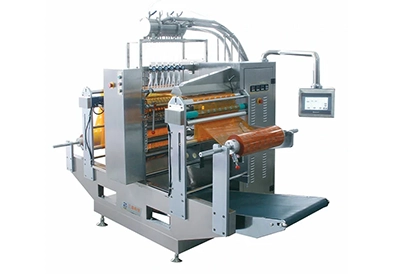
The DXDO-W900E Water Pills four side sealing & multi-line packing machine from chinapackagemachinery.com is built around the relationship between metering, film, and lane count described above: a 900mm web feeding 4–6 lanes, a 1–50ml fill range, four-side roller sealing, and 30–40 bags/min across a 50–150mm pouch length. The PLC and frequency changer give the operator control over cycle timing and sealing parameters, and the photoelectric tracking system keeps registration steady on double-face printed film across all lanes. For a producer moving small solids into unit-dose sachets, that combination means the Granular Packaging Machine can be tuned to the product and the laminate rather than run on a single fixed recipe—and the four-side seal format keeps the dose where it belongs.
A film trial is only meaningful if it matches production conditions. Bring the actual laminate, the target pouch dimensions, and the fill weight. Run at the intended lane count and speed, then check seal integrity, registration, and fill consistency across every lane—not just the center one. The page's specifications give a starting point; the trial confirms whether the setup holds at your line rate.
Send over your fill weight, pouch dimensions, lane count, and film structure—we'll help you check them against the DXDO-W900E's fill range, film width, and sealing configuration. Talk to chinapackagemachinery.com about your Granular Packaging Machine requirements and get a format-level answer before you commit to a roll order.
~1-1515-1351.webp)

 English
 Pусский
 Español
 عربي