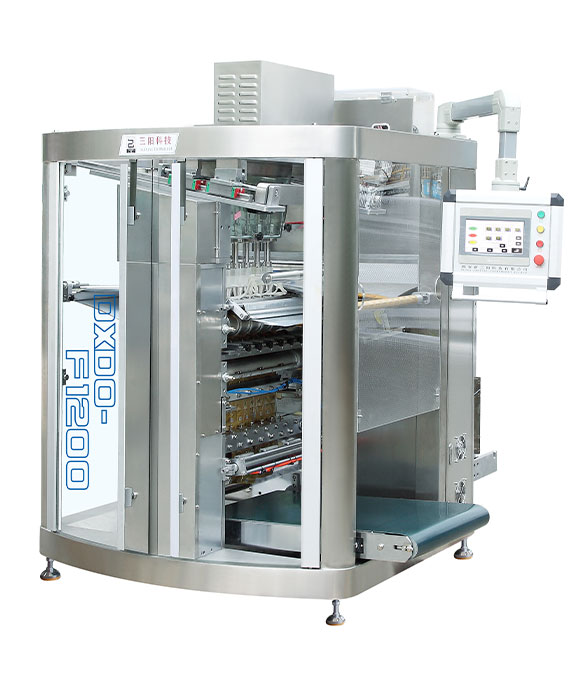
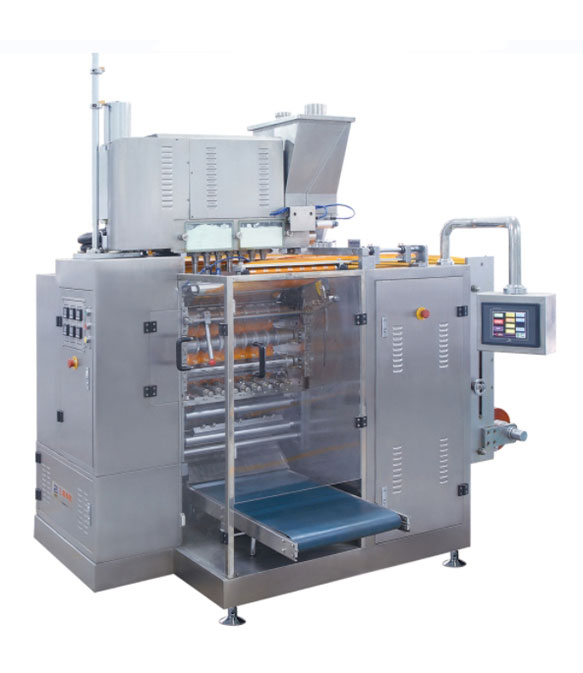
The machine starts with a roll of flat film. The film feeds through a series of rollers, folds into a tube, and passes under a filling nozzle. The nozzle drops a precise amount of sauce — 1ml for a single‑serve ketchup packet, 100ml for a family‑size chili sauce pouch. Then the sealing bars close: first the vertical seal (the back seam), then the horizontal seal (the top and bottom). The cutting knife separates the finished pouch from the film web. All of this happens in less than two seconds.
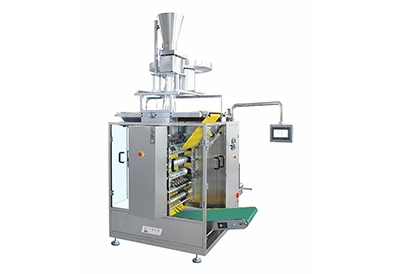
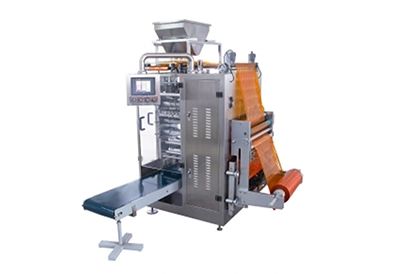
That sequence describes a sauce packaging machine — a vertical form‑fill‑seal system designed for liquid and paste products. The DXDO-J900E is one example of this machine type. It fills pouches from 1ml to 100ml at a speed of 30 to 60 cycles per minute, depending on the pouch size and the viscosity of the sauce. The film width capacity is 900mm, and the machine can run multiple lanes simultaneously, producing several pouches per cycle.
This article explains how the machine meters paste without leaving a trail of sauce across the seal area, why the four‑side seal produces a pouch that stands up on a shelf better than a three‑side seal, and where the 12kW power consumption goes.
A sauce packaging machine with five independent servo motors synchronizes the film feed, the filling nozzle movement, the vertical sealing bar, the horizontal sealing bar, and the cutting knife. The DXDO-J900E uses a five‑axis servo control system. Each axis reports its position back to the PLC. The controller adjusts the timing of each axis in real time, so the filling nozzle is never in the way of the sealing bars, and the cut happens exactly between pouches.
The servo design allows the machine to change pouch length without mechanical adjustment. The operator enters the new pouch length on the touch screen. The film feed servo advances the web by the new length, the vertical seal axis holds for the correct dwell time, and the horizontal seal axis times its closure to match. A mechanical machine would require a gear change or a cam adjustment. The servo machine does it in seconds.
The five axes are:
Film feeding servo – pulls the film from the roll and advances it through the forming tube.
Vertical sealing servo – closes the back sealing bar for the required time.
Horizontal sealing servo – closes the top and bottom sealing bars.
Filling pump servo – meters the exact volume of sauce into the pouch.
Cutting knife servo – actuates the knife at the correct interval.
The servo drives are rated for continuous operation. The machine runs 24 hours a day without overheating, as long as the ambient temperature stays within 0‑40°C.
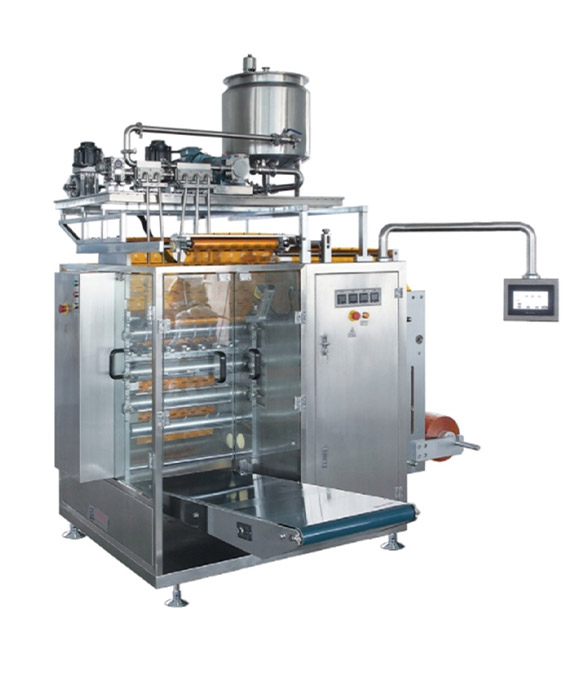
A three‑side seal pouch is folded from a single sheet of film. One edge is the fold line, not a seal. The pouch lies flat. A four‑side seal pouch is cut from a flat web and sealed on all four edges. The bottom seal is horizontal, the side seals are vertical, and the top seal is horizontal. The pouch can stand upright on its bottom edge, like a miniature bottle. This shape is called a stand‑up pouch or gusseted pouch.
The DXDO-J900E produces four‑side seal pouches. The film former shapes the web into a tube, but the sealing sequence creates two parallel side seals and a separate bottom seal. A four‑side seal sauce packaging machine is more complex than a three‑side seal machine because it requires additional sealing bars and more precise registration. The benefit is a finished pouch that displays the brand logo vertically on a store shelf, with the filling facing the customer.
The pouch dimensions range from 50‑300mm in length and 35‑105mm in width. For a 50×35mm pouch, the machine runs at the higher end of the speed range (60 cycles per minute). For a 300×105mm pouch, the speed drops to 30 cycles per minute because the sealing bars have a longer stroke and the film feed must travel farther between cycles. The film thickness range is not published in the summary, but the machine typically handles 30‑100µm laminates, including PET, PE, and aluminum foil structures used for barrier packaging.
A sauce packaging machine must fill watery liquids and semi‑solid pastes without dripping or clogging. The DXDO-J900E uses a rotary piston pump or a peristaltic pump depending on the product viscosity. The filling accuracy is ±1% of the target volume. For a 1ml single‑serve, ±1% is ±0.01ml — acceptable. For a 100ml family pouch, ±1% is ±1ml — the machine will overfill or underfill by up to 1ml per pouch.
The pump speed is controlled by a servo motor. The operator sets the volume per stroke on the touch screen. The PLC calculates the required rotation angle of the pump rotor. For a peristaltic pump, the tube must be changed every 500‑1,000 operating hours because the rotor wears the tube wall. For a piston pump, the seals need replacement after 2,000 hours. The machine includes a cleaning mode where the pump runs at high speed to circulate cleaning solution through the nozzle and the filling tube. The system is designed for CIP (clean‑in‑place) operation — the operator connects a cleaning solution supply to the pump inlet, and the machine flushes the product contact parts without disassembly.
The machine handles products with viscosity ranging from water‑thin (1,000 cP) to thick paste (50,000 cP). Tomato ketchup is about 10,000‑20,000 cP. Peanut butter is 50,000‑100,000 cP — at the upper limit. For peanut butter, the filling nozzle must be heated to prevent the paste from solidifying. The DXDO-J900E has an optional heated nozzle block with independent temperature control. The temperature is set on the touch screen and maintained within ±2°C by a PID controller.
| Product | Viscosity (cP) | Recommended Pump | Nozzle Heating |
|---|---|---|---|
| Hot chili sauce | 1,000‑5,000 | Peristaltic | Not required |
| Ketchup | 10,000‑20,000 | Rotary piston | Not required |
| Mayonnaise | 20,000‑40,000 | Rotary piston | Optional |
| Peanut butter | 50,000‑100,000 | Rotary piston with scraper | Required |
| Jam with fruit pieces | 15,000‑30,000 | Rotary piston with chopper | Not required |
Data sourced from common packaging industry references for similar machine types.
The DXDO-J900E is controlled by a PLC with a touch screen HMI. The operator stores the parameters for each product: filling volume, pump speed, sealing temperature, pouch length, and cutting knife timing. The recipe is saved by product name. When the line changes from ketchup to chili sauce, the operator recalls the chili sauce recipe. The machine sets the filling volume, adjusts the sealing temperature (chili sauce may require a different seal temperature because of its pH), and loads the correct pouch length. A changeover that takes 20‑30 minutes on a mechanical machine takes under 5 minutes on the servo‑driven DXDO-J900E.
The touch screen also displays real‑time diagnostics: current speed, production count, fault codes, and maintenance reminders. When the pump reaches its scheduled cleaning interval, the screen prompts the operator to run a CIP cycle. The operator presses a button, and the machine automatically flushes the product path with cleaning solution, then rinses with water. The CIP cycle takes 10‑15 minutes, during which the machine does not produce pouches. The operator does not need to disassemble the filling head.
The sealing temperature depends on the film structure and the sauce's chemical composition. A tomato‑based sauce with high acidity may require a lower seal temperature to prevent the film from delaminating. A neutral pH sauce can be sealed at a higher temperature. The DXDO-J900E has separate temperature controllers for the vertical seal, the horizontal seal, and the optional heated nozzle. Each controller has a PID loop and a solid‑state relay. The temperature range is 50‑200°C, adjustable in 1°C increments. The sealing bars are PTFE‑coated to prevent sauce from sticking to the hot surface. The coating must be inspected monthly for wear; a worn coating will cause the film to adhere to the bar, resulting in a torn pouch.
The DXDO-J900E is rated at 12kW. That includes the main drive motor, the five servo axes, the sealing bar heaters, the film unwinder, and the pump motor. On a 380V three‑phase supply, the current is about 18A. On a 220V single‑phase supply, the current would exceed 50A — too high for a standard outlet. The machine requires three‑phase power. Most industrial kitchens and small food processing plants have three‑phase available. A startup operating from a residential‑style electrical service may need to install a three‑phase converter or choose a smaller machine.
The machine footprint is not specified in the summary, but a typical VFFS machine with a 900mm film width occupies about 4‑5 meters in length, 1.5 meters in width, and 2 meters in height. The operator needs space in front of the touch screen for a stool, space behind the machine to load film rolls, and space at the delivery end to stack finished pouches. The CE certification on the DXDO-J900E means the machine meets European safety standards, including emergency stops, guard interlocks, and electrical isolation. For a food plant exporting to Europe, the CE mark is a legal requirement.
Sanyang Technology (Ruian Sanyang Technology Co., Ltd.) manufactures the DXDO-J900E hot sauce filling machine for small to medium‑sized food processors. The machine is designed for sauces, pastes, and condiments. It fills 1‑100ml pouches at 30‑60 cycles per minute with ±1% accuracy, uses a five‑axis servo drive, produces four‑side seal stand‑up pouches, has a 900mm film width capacity, stores recipes on a PLC touch screen, and is CE certified. A sauce packaging machine that fills 1ml of hot sauce without dripping, changes from ketchup to chili sauce in five minutes, and seals pouches that stand upright on a store shelf keeps a small food plant profitable. For a hot sauce startup scaling from kitchen batch cooking to retail packaging, the DXDO-J900E delivers the accuracy, speed, and flexibility that a growing brand requires.
【Request a quote from Sanyang Technology】
Contact Sanyang with your target pouch size (length 50‑300mm, width 35‑105mm), product viscosity, and daily output requirement to receive a DXDO-J900E configuration recommendation and a video of the machine running your sauce.

 English
 Pусский
 Español
 عربي
عربي .jpg)