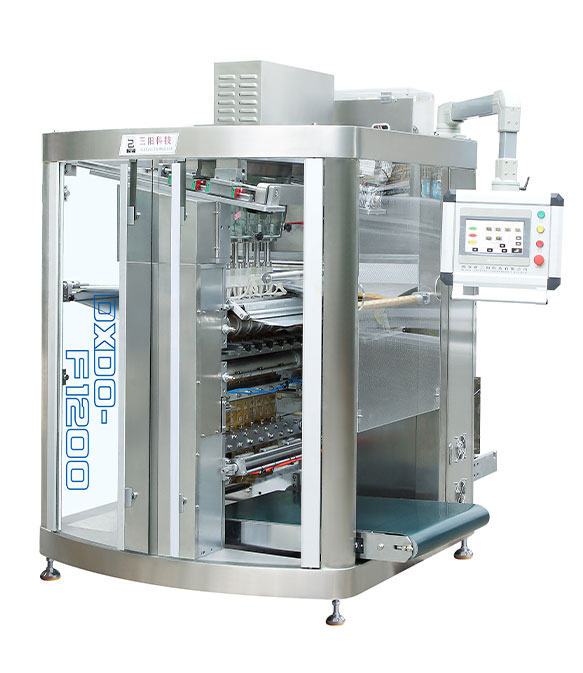
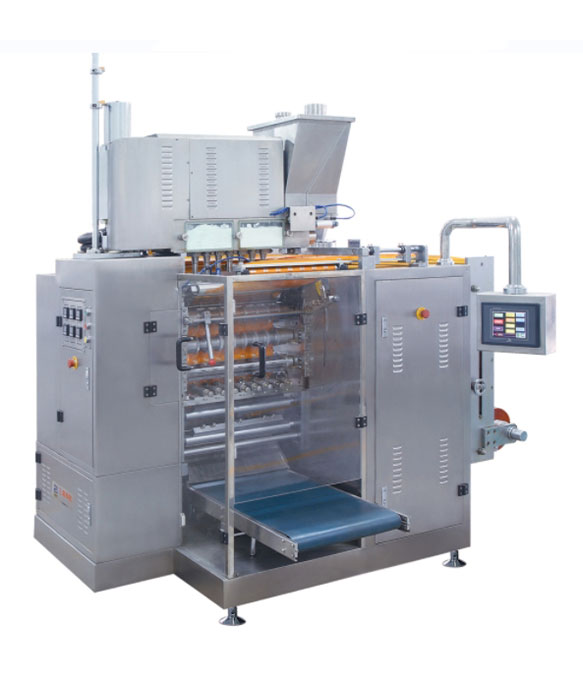
A Powder Packaging Machine that relies on mechanical cams has to be re-tooled when the bag size changes—new cam profiles, new sealing jaw positions, new film path. A servo-driven machine sets those positions through the controller instead. You'll see how the DXDO-F900E uses that architecture to change bag sizes without molds, what the servo and PLC layers contribute, and where the fill and film envelope sits.
On a cam-driven machine, the bag length is set by the cam profile that drives the sealing and cutting motions. Changing the length means changing the cam. On the DXDO-F900E, the page lists a five-axis servo synchronous drive and stepless bag length adjustment, with a bag length range of 50–120mm. The servo axes move to the new position commanded by the controller, so the length change is a parameter entry on the touch screen rather than a hardware swap.
The bag width is set by the film path geometry and the sealing jaw width, not by the length cam. The page lists a pouch width range of 60–105mm across a maximum film width of 900mm. When the pouch width changes within that range, the film path and the lane layout are re-referenced through the controller. The sealing jaws and the film guide positions are adjusted to the new width, and the photoelectric tracking re-aligns the print register to the new pouch position.
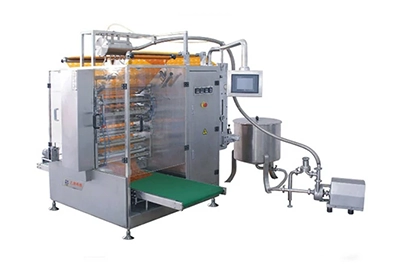
The page lists a five-axis servo synchronous drive, a humanized touch adjustment interface, and precise PLC control. Those three elements work as one control layer: the servos position the film, the sealing jaws, and the filling station; the PLC coordinates the sequence; and the touch screen is where the operator adjusts the parameters.
| Parameter | DXDO-F900E (from the product page) |
|---|---|
| Packing speed | 30–50 times/min |
| Filling capacity | 1–30ml |
| Pouch length | 50–120mm (stepless adjustment) |
| Pouch width | 60–105mm |
| Max film width | 900mm |
| Max film diameter | Φ300mm |
| Film core diameter | Φ75mm |
| Applicable film | PET/AL/PE, PET/PE, NY/AL/PE, NY/PE |
| Electric source | 380V 50Hz (customizable) |
| Total power | 14kW |
| Overall dimension | 2600×1900×2200mm |
| Machine weight | 1500kg |
The touch screen is the interface, but the servo axes are what actually move. A machine with a touch screen but a cam-driven mechanism would let the operator enter a new bag length and then fail to produce it. The five-axis servo layout is what turns the entered value into a mechanical position—the film feed, the sealing jaws, and the cutting station all move to the commanded positions. The screen is only as useful as the axes behind it.
The DXDO-F900E uses a high-precision integral rolling heat sealing roller system to form the four-side seal, with the sealing temperature controlled to ±1°C accuracy. When the bag size changes, the sealing roller has to close on a different pouch geometry—a longer bag means a longer seal path on the side edges, and a wider bag means a wider seal on the top and bottom.
That's where the ±1°C control earns its place across a size change. A new bag geometry changes the dwell time at the sealing roller, because a longer pouch passes through the roller over a longer period. The temperature control has to hold the setpoint through that different dwell, or the seal strength changes with the size. The page's ±1°C figure is the machine-level window that keeps the seal consistent from one bag format to the next.
Sealing system: integral rolling heat sealing roller
Temperature control: ±1°C accuracy
Seal format: four-side seal on every pouch
Cutting options: flat knife, virtual knife, or special-shaped knife
Discharge nozzle: lifting mechanism for powder filling
The page lists flat knife, virtual knife, and special-shaped knife as cutting options. A flat knife produces a straight edge, a virtual knife produces a tear line, and a special-shaped knife produces a shaped edge. When the bag size changes, the cutting position moves with the new bag length, but the knife type itself doesn't have to change unless the bag format requires a different edge. That's another way the size change stays a parameter adjustment rather than a tooling swap.
The filling capacity is 1–30ml per sachet, covering small pharmaceutical portions through single-serve milk powder and coffee formats. The filling system uses servo motor control with material level detection and a rotary feeding mechanism to keep the fill weight consistent across lanes.
The film options are PET/AL/PE, PET/PE, NY/AL/PE, and NY/PE. The AL-containing structures (PET/AL/PE and NY/AL/PE) include an aluminum layer that adds a moisture barrier beyond what the seal alone provides. For milk powder, that combination—four-side seal plus an AL-containing film—is the two-layer moisture defense the application calls for.
Fill range: 1–30ml, servo-driven with level detection
Film structures: PET/AL/PE, PET/PE, NY/AL/PE, NY/PE
Bag length: 50–120mm, stepless adjustment
Bag width: 60–105mm
Lane count: 4–6 lanes across the 900mm film width
Photoelectric tracking: aligns the seal to the printed pattern
A bag size change doesn't happen in isolation—the film structure has to suit the new format as well. A thinner PET/PE structure may run cleanly on a small sachet but lose barrier performance on a larger one where the surface-to-volume ratio is different. The AL-containing structures add moisture protection, which matters more as the sachet gets larger and the product sits in it longer. The size change and the film choice are reviewed together, not sequentially.
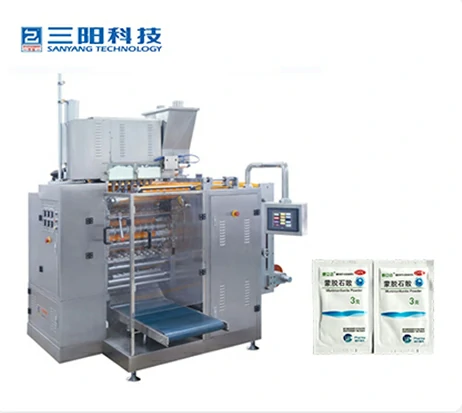
The Powder Packaging Machine DXDO-F900E from SanYang Technology is built around the servo-driven architecture the page describes: a five-axis servo synchronous drive, PLC control with a touch screen interface, stepless bag length adjustment from 50–120mm, and a four-side sealing roller system with ±1°C temperature control. The filling range of 1–30ml and the bag width range of 60–105mm cover single-serve milk powder, coffee, flour, and pharmaceutical powder formats, and the 4–6 lane configuration runs at 30–50 cycles per minute. For a powder producer running multiple sachet sizes across a shift, the value sits in the changeover—the bag length and width move through the controller, the sealing roller holds its temperature through the new dwell, and the photoelectric tracking re-aligns the print register without a mold change.
Confirm the fill weight against the 1–30ml range, the bag dimensions against 50–120mm length and 60–105mm width, and the film structure against the PET/AL/PE, PET/PE, NY/AL/PE, or NY/PE options. Check the powder's flow behavior against the rotary feeding and level detection system, and the required barrier against whether the film includes an AL layer. The page's specifications give the starting point; a trial on the actual powder and film confirms whether the four-side seal and the fill accuracy hold across a size change at 30–50 cycles per minute.
Send over your fill weight, bag dimensions, film structure, and how many sizes you run per shift—we'll help you check them against the 1–30ml fill range, the 50–120mm bag length, and the stepless adjustment envelope. Talk to SanYang Technology about your Powder Packaging Machine requirements and get a format-level answer before you commit to the tooling.
~1-1515-1351.webp)

 English
 Pусский
 Español
 عربي